
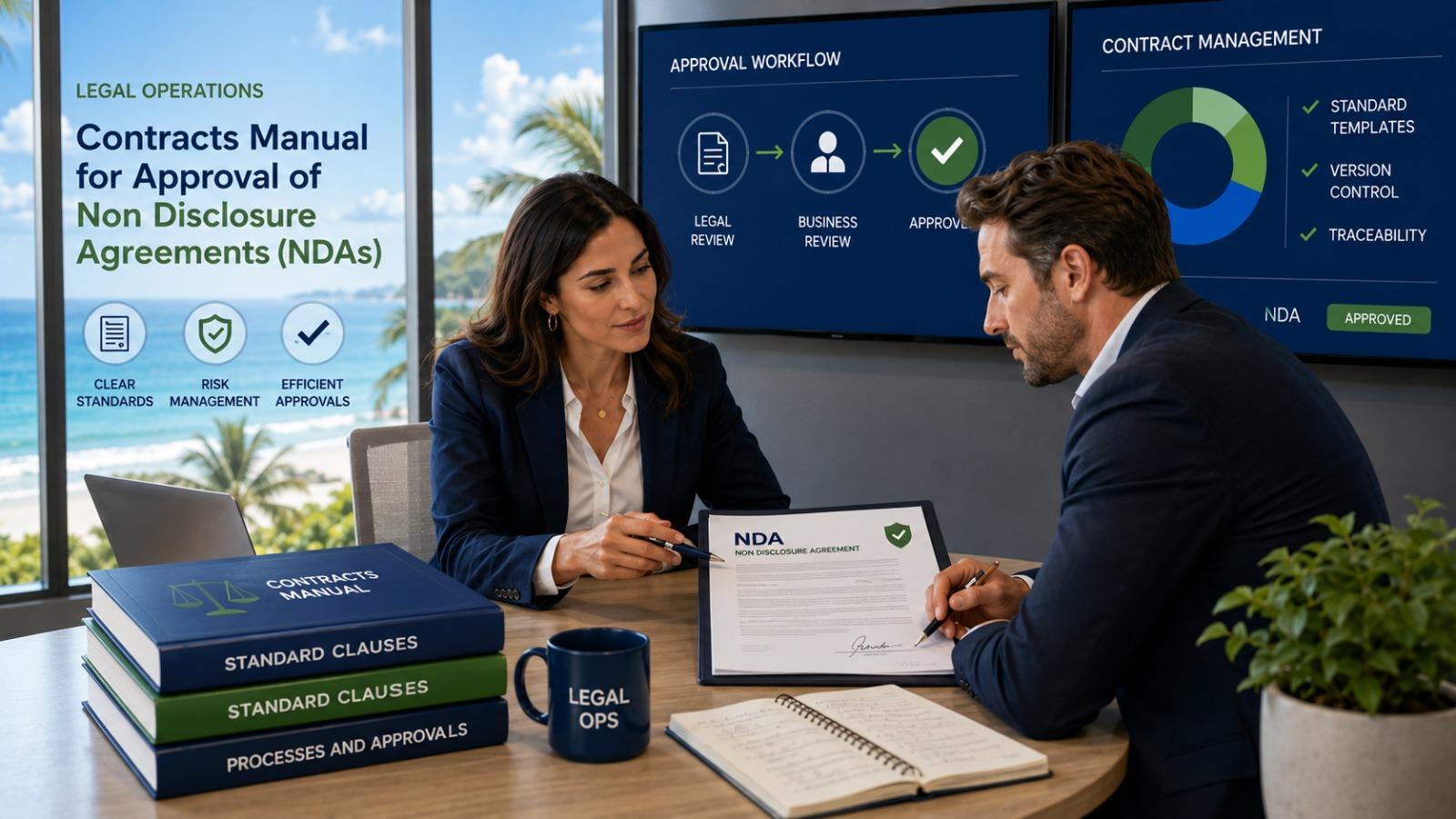
LEGAL OPERATIONS IS NOT A GENERAL COUNSEL WITH DIFFERENT BRANDING
There’s a quiet identity crisis happening inside a lot of legal operations roles right now. You get hired with the goal of transforming how the business handles contracts and speeds deals up. Then, you realize you’re just doing what an in house counsel has always done, except now you also own a dashboard. That’s not legal ops. It’s legal, rebranded.
Real legal operations is a discipline of design. It’s not about reviewing contracts faster. It’s about building the system that lets the business make good decisions without needing you in the room every time. And nothing shows that difference more clearly than a playbook.
I want to walk through why that matters, starting with the problem most companies don’t realize they have, and why NDAs are the smartest place to prove this out.
The real reason contracts slow you down
Ask any founder or COO what frustrates them about legal, and they can say some more or less diplomatic corporate lingo version of “the lawyers are slow,” but that’s rarely the actual issue. The real problem is that every contract review starts from zero.
One person on the team approves a clause without blinking. Another flags the exact same clause as a dealbreaker. A third only asks Legal for input once the commercial terms are already locked and the counterparty is waiting on a signature. None of this is because anyone did anything wrong. It’s because nobody ever wrote down what “acceptable” actually means for the company.
So, the bottleneck people blame on Legal is usually a symptom of something else entirely: a company that has never turned its own judgment into a documented process that is replicable and that can be scalable.
Why a playbook fixes a business problem
This is where a playbook can earn a well deserved place as an operating manual for decisions.
A good playbook tells your team, and by team I mean all company team, in plain terms, what’s fine to accept, what needs a small tweak, and what genuinely needs to come back to Legal. That’s it. No ambiguity, no guessing, no waiting around for someone senior to weigh in on something that actually should be pretty routine.
For a founder or CEO, the upside is operational, because deals close faster. There’s less ping pong game between departments. The company stops depending on whichever person happens to remember how we handled this last time. And as you scale, that consistency becomes the difference between a legal team that keeps up and one that quietly becomes the reason deals slow down.
Why teams push back on playbooks, anyway
Here’s the part that surprises people: even when a playbook is genuinely useful, teams often resist it at first, because most playbooks they’ve encountered were never built for them. They were built for lawyers, in legal language, with clause references and conditional logic that means nothing to someone in sales trying to close a deal by Friday. If the first thing your team sees is dense legal terminology, their brain files it under “not my job” and moves on.
There’s also a trust issue hiding underneath. Business teams are wired to move fast, and anything that looks like process can feel like a roadblock, especially if nobody explained the reasoning behind it. When Legal hands over a rule without context, the rule becomes the enemy.
The fix isn’t a colorful PDF. Once people understand that the playbook exists to help them decide faster and avoid getting blindsided later, resistance tends to fade. You’re not adding friction. You’re removing the guesswork that was slowing them down in the first place.
Why are NDAs the perfect place to start
If you’re building your first playbook, don’t start with your MSA or your SaaS agreement. A better starting point is NDAs. They’re around every day. Almost everyone in a company has signed one or sent an NDA out for signature, and most companies already have a template. What’s missing is not the NDA, but a consistent way to look at it: what actually matters to protect, what can be waved through, and when does this need a second set of eyes.
A useful NDA playbook starts before the redline even happens. It starts with context: what’s this deal for, who’s involved, what information are we actually about to share. From there, you move into the handful of clauses that carry real risk, things like purpose, the definition of confidential information, IP ownership, know how, term, and governing law. Then you’re clear on what’s standard, what has acceptable alternative language, and what needs to go to someone senior before it moves forward.
Once your team sees an NDA get handled cleanly and quickly using this structure, something shifts. The playbook stops being “a legal thing” and starts being “how we do this here.” That mindset is what makes it possible to extend the same logic to bigger, messier contracts later.
What this is really building toward
At its core, a playbook is a way of taking legal judgment out of one person’s head and putting it into a system the whole business can use. That’s the entire point.
For founders and COOs, that means faster turnaround, fewer unnecessary escalations, and real confidence that risk isn’t being handled by improvisation. For legal counsel, it means finally getting off the hamster wheel of answering the same question for the hundredth time and spending that energy on the problems that actually need a lawyer’s brain.
And for legal ops, this is the whole job. Not reviewing more, faster. Designing the thing that means fewer reviews are even necessary, I think that’s the game changer.